


The Gulf’s Harder Balance: Iran’s Strategic Paralysis vs Israel’s Impulse
- Andreas Krieg
- Feb 11
- 5 min read
This is a moment in which the Gulf has to balance between an Iran that has been largely passive and reactive since the 7th of October and an Israel that has been erratic, impulsive and hyper activist in pursuit of short to midterm security interests.

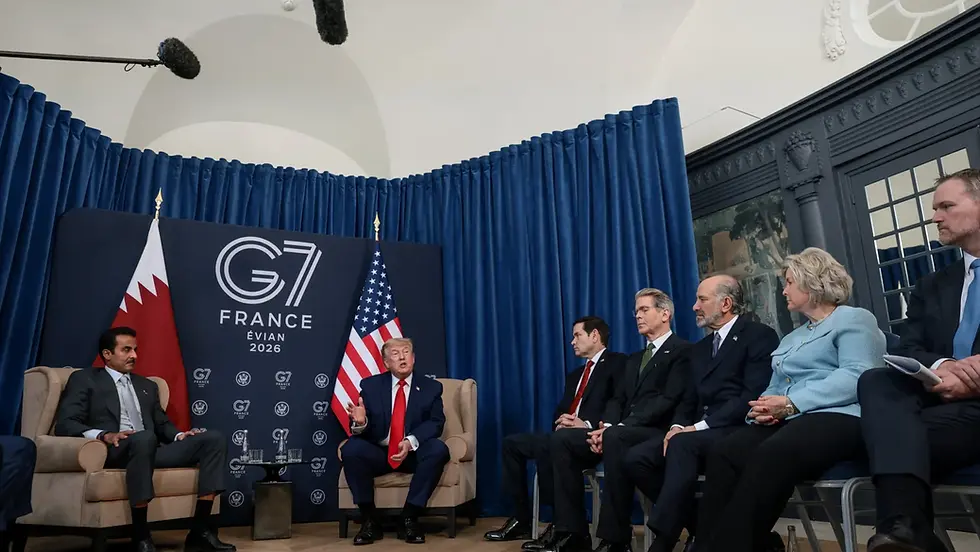
President Trump says the nuclear talks in Oman were “very good”. He claims Iran wants a deal “very badly”, and he points to Muscat as proof that diplomacy can still breathe in a region pushed by Israel into a spiral of escalation. Those lines are designed to steady markets, reassure allies and, perhaps, warn Tehran that Washington has alternatives. Yet the Gulf capitals listening closest hear something else: an opening that may close quickly. This is a moment in which the Gulf has to balance between an Iran that has been largely passive and reactive since the 7th of October and an Israel that has been erratic, impulsive and hyper activist in pursuit of short to midterm security interests.
Iran once pursued a strategic long-term vision: a networked state with mosaic layers of defence across the region. It built depth through proxies, supply lines, political patrons and economic dependencies, so that any strike on Tehran would ricochet through Baghdad, Damascus, Beirut and beyond. Israeli military activism has steadily degraded that architecture since October 7th. In many ways the Iranian frog has been boiled slowly. The old man at Iran’s helm is passively trapped in state of strategic drift, unwilling to give clear directions, unable to take risks, endlessly balancing between hard liners and even harder liners. And Reformists at the moment exist only on the periphery of statecraft, tolerated as décor rather than trusted as decision makers. What remains is a regime that can still sting but fails to steers proactively and assertively.
Israel meanwhile has been acting like a bull in a china shop, willing to drag the region into permacrisis. Quick and daring military actions generate short term tactical gains, which Israel fails to translate into long-term stability. In Lebanon Hezbollah is weakened but far from defeated. In Syria Israel is upsetting a fragile sociopolitical balance, but it is unable to contribute to meaningful change as the world is embracing the new Syrian President’s project to unite the country. In Yemen Israeli punitive strikes against the Houthis have emboldened the militia, reinforcing its narrative of resistance. Most damaging of all, the Israeli strike on Qatar has triggered the Gulf monarchies to reprioritise. For them – with the exception of Abu Dhabi - Israel has largely been elevated to the primary threat to regional security overtaking Iran.
This is the context in which the Gulf states are trying to mediate a deal between the United States and Iran. Oman is taking the lead, hosting talks between Washington and Tehran, and trying to hammer out a framework that Qatar, Turkey and Egypt have helped shape, with Saudi Arabia and the United Arab Emirates supporting from behind. There is a broad consensus that war with Iran will not be an easy in, easy out campaign, which President Trump has been celebrating over Venezuela. Striking the Islamic Republic risks opening Pandora’s box of regime change, with the Revolutionary Guard likely to respond with unlimited warfare if survival is at stake. More concerning for Gulf states is that they would be left to manage the aftermath of further regime degradation, with a risk of messy infighting and the collapse of sovereignty.
The Trump administration is clear it does not want a lengthy campaign that would tie Washington to expensive and exhaustive ‘stabilisation’, a dirty word in post Iraq America. Equally, punitive strikes on Iran alone will not make much of a difference on the ground. They may crater a site, but will not strategically weaken a system built to absorb pain and bounce back.
Idealists in the anti-regime diaspora have to accept that for the Trump administration the potentially tens of thousands of youth protestors killed by the regime in Iran are not more than a talking point. More appealing to America First is a deal that enables sanctions to be gradually lifted and American companies to profit from the region’s potentially biggest market. This is where Gulf and America First interests overlap as Gulf capitals hope they can cash in as gateways into post-sanction Iran.
It is thus not surprising that the Trump administration has been swayed by the Gulf to give diplomacy a chance, even if the first draft looks a lot like a JCPOA 2.0. The idea is that with a nuclear deal agreed, the contentious issue of missiles – the backbone of Iranian strategic autonomy – can be discussed further down the line.
But to keep Kushner, Witkoff and Trump invested,the Gulf states must balance between an Iranian regime trying to procrastinate and prolong negotiations to avoid a military strike, and an Israel under Netanyahu trying to force America’s hand as long as the momentum for military action lasts. Israeli information networks are already mobilising anti-Iran hawks to make the case for war. And Israeli security officials threaten Israel might go it alone if diplomacy yields only another n.uclear deal without Iran surrendering the missile programme.
In Washington, the Gulf lobby and America First are trying to pull the President from the abyss, as neo conservatives make the case for Israel First, framing policy as a test of loyalty rather than judgement. The result is a complex of binary choices and wicked problems that the US President despises: strike or appease, contain or topple, Israel First or America First. In that atmosphere, nuance looks like weakness and patience can easily be caricatured as drift. Gulf diplomacy therefore extends beyond managing the bilateral relationship between Iran and the United States government. It also involves protecting the White House from being captured by the spectacle of Netanyahu arriving yet again in Washington to set America’s policy tempo.
Between Iranian paralysis and Israeli impulsion, the Gulf’s mediators are not simply brokering terms, they are synchronising clocks. Iran wants time because time dilutes pressure. Israel demands urgency because urgency shrinks diplomatic space. The United States oscillates because its politics reward drama more than discipline.
For Muscat and its Gulf neighbours to succeed, the Gulf must translate presidential praise into a process that is fast enough to deter Israeli adventurism yet structured enough to expose Iranian stalling. That requires clear milestones, reciprocal steps and consequences that do not automatically mean war. Yet should Iran choose to delay and protract, President Trump has few options available but to give in to Israeli and neo conservative pressure. A deal, then, is not a prize. It is the region’s only insurance policy.


Comments